 NexChat-客服系统-官方博客
On July 22, OpenAI launched a dedicated Presence agent solution for enterprise service scenarios, focusing on setting rules and system permissions for specific roles rather than providing a universal chat box. Around the same time, Bank of America announced a generative AI upgrade to EricaAssist, a tool used by its 18,000 customer service employees, enabling agents to obtain personalized guidance within seconds.
If you have just taken over the operation or system selection for an AI customer service project, these frequent industry updates can be overwhelming with complex concepts. From early simple keyword matching to today's agents and agent collaboration, the service architecture has undergone profound changes. Understanding the core logic helps newcomers quickly build a clear picture.
What is the fundamental difference between agent-based AI customer service and traditional Q&A bots?
Early Q&A bots mainly relied on keyword matching or simple Retrieval-Augmented Generation (RAG). Their logic was "you ask a question, I find a sentence from the document." The latest agent form emphasizes independently completing cross-system workflows under clear strategies and security boundaries.
Taking the newly released tools as an example, each agent is assigned an extremely clear single "role responsibility," such as only handling bill inquiries or only managing returns and exchanges. It can not only understand customer intent but also call internal interfaces with authorization to help customers conduct business. More critically, the system accesses data on demand, ensuring accurate and controlled output.
Why do enterprises no longer pursue complete replacement of agents by machines?
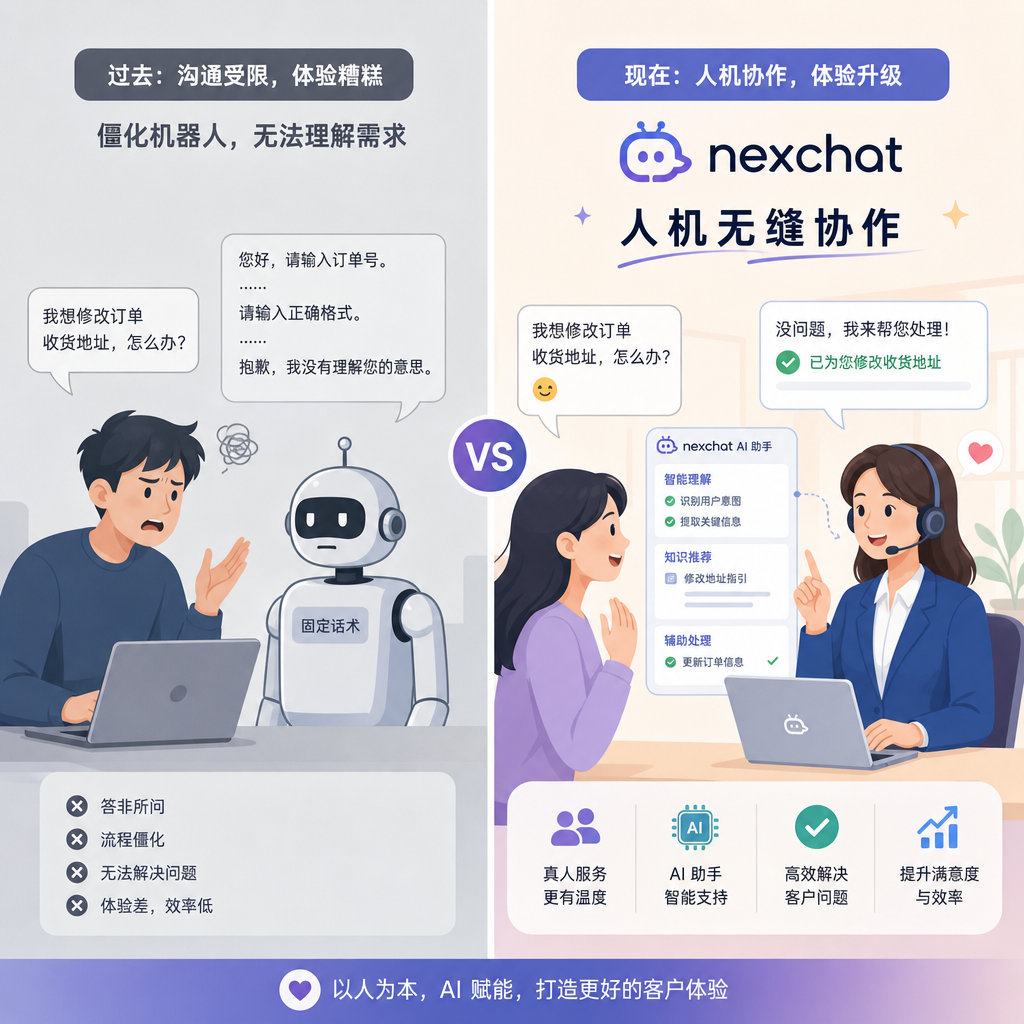
In the past, many enterprises mistakenly believed that introducing large models could fully replace agents, but the latest industry feedback tells a different story. A study released on July 22 by a third-party agency, covering 3,000 consumers, showed that when users know they can be transferred to a human at any time, 80% are willing to use machine services; once the human channel is completely cut off, users' trust in machine services drops sharply.
Facts show that machines are better at handling 24/7 repetitive responses and rapid efficiency improvement, while complex disputes and emotional comfort still require human intervention. For example, after Bank of America upgraded its agent assistance tool, AI provides real-time prompts on customer history and resolution suggestions in the background, saving nearly one minute per call on average. This form of "front-end human-machine collaboration, back-end intelligent assistance" is becoming the preferred way for enterprises to balance cost and user experience.
How should newcomers define the boundaries of human-machine division when planning systems?
When starting to build business processes, the worst mistake is to hand over all business to the machine at once. A reasonable division principle is to classify according to two dimensions: "degree of task standardization" and "emotional complexity."
During specific deployment, refer to the following division:
- Priority automation: High-frequency, standardized query requests, such as logistics tracking, business hours confirmation, password reset guidance;
- Human-machine collaboration: Business requiring multi-step confirmation or with limiting conditions, where the agent collects basic information and generates processing suggestions, then the agent clicks to confirm;
- Must be manually taken over: Scenarios involving high refunds, serious complaints, or emotional customers, where keywords trigger direct transfer to human.
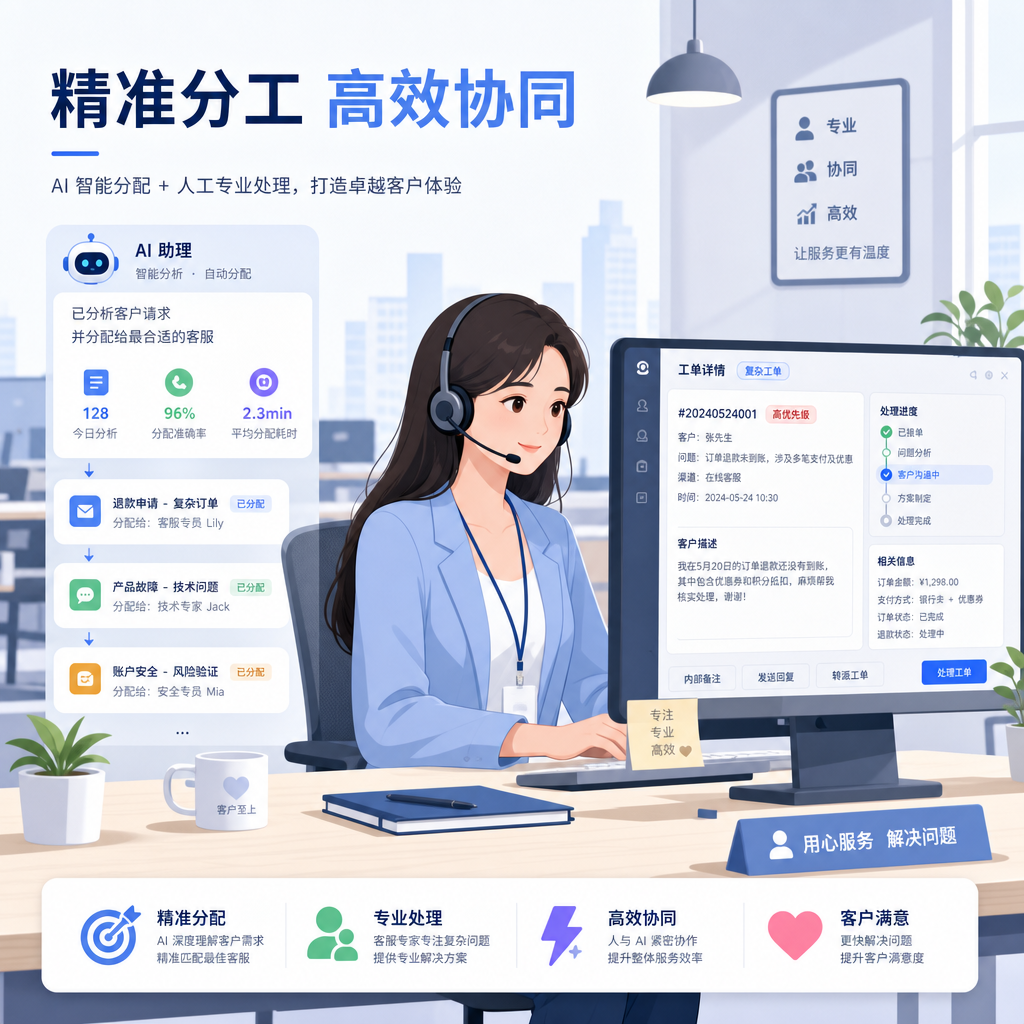
In architecture selection, online customer service systems like nexchat provide flexible routing rules and seamless takeover mechanisms. When the agent identifies complex semantics or the user requests a transfer, the complete conversation context is pushed to the agent workstation, ensuring no repetition by the customer.
What metric pitfalls are newcomers most likely to step into when evaluating system implementation?
Newcomers often fall into the trap of "interception rate only," thinking that the more users intercepted by machines, the better. But if users close the window in anger due to irrelevant answers, such "passive interception" harms brand trust. To build a healthy evaluation system, focus on the following core metrics:
- First Call Resolution (FCR): Whether the customer's problem is truly resolved in the first interaction, not just the number of replies;
- Seamless Transfer Rate: The rate of complete context transfer when switching from machine to human agent, avoiding repeated communication;
- Average Handle Time (AHT): Whether the time for a human agent to resolve a single complex ticket decreases after the intelligent assistant is launched;
- Customer Satisfaction Score (CSAT): Collect scores separately after machine conversations and human takeover, comparing real reputation across channels.
In actual optimization, through nexchat's multi-dimensional data dashboard, you can clearly see transfer nodes and unsubscribe reasons at each stage, allowing targeted updates to the knowledge base or optimization of transfer logic.


Comments(0)